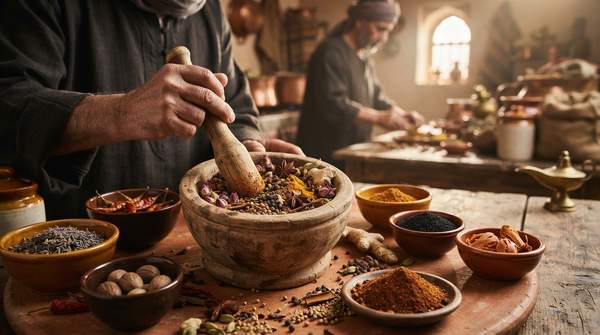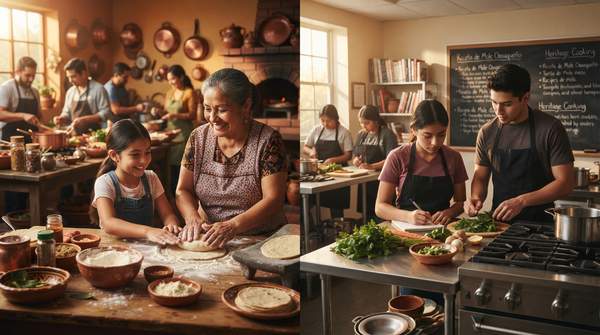
Food education preserves culinary traditions through two distinct models: formal, school-based programs that weave food into academic curricula to build broad cultural literacy, and informal, community-led heritage projects that reclaim specific culinary narratives and foster solidarity among diasporic and marginalized communities. Each model pursues a different kind of preservation—one aims at general understanding across a whole student population, the other at deep, targeted engagement with a particular heritage. Understanding how their goals, methods, and outcomes differ helps explain why both are needed.
Introduction: Food Education as a Pillar of Cultural Preservation
Culinary traditions are unusually fragile carriers of culture. They live in kitchens, memories, and markets rather than in archives, and they disappear when a generation stops cooking or a community's history is quietly erased. Education is one of the main mechanisms that keeps them alive. The Food Studies Institute, writing about food education in schools, describes how preparing traditional dishes from around the world makes learning about different cultures "interactive and memorable, fostering cultural acceptance and curiosity."
But education does not have to happen in a classroom. The University of British Columbia's Faculty of Arts makes this point directly: education "doesn't need to be 'academic' or take place in a classroom setting," and programming is "most impactful when we intentionally meet people where they're at." That insight frames the comparison in this article. The two models below differ less in their commitment to cultural preservation than in where they work, whom they reach, and what kind of cultural continuity they produce.
Formal School-Based Food Education: Structured Learning for Broad Cultural Literacy
The school-based model embeds food into the existing educational system. Its primary goal is broad cultural literacy: students learn about food systems, nutrition, and the cultural dimensions of cuisine alongside conventional subjects. According to the Food Studies Institute, culinary activities in the classroom cultivate skills such as attention, patience, planning, and organization, while group cooking projects build communication, problem-solving, and leadership. By engaging with diverse cuisines, students explore "culture, identity, tradition, geography, agriculture, and art" in a single, integrated lesson.
The methods are structured and interdisciplinary. Food topics are woven into standard academic subjects, and hands-on activities are designed to engage different types of learners in cooperative group work. The institutional commitment this model requires is illustrated by one public school's decision, described by the Food Studies Institute's Ariel Demas: after three years of grant funding, the principal created what may have been the first full-time food educator position in a public school, likening the cost to hiring an art teacher and purchasing supplies. The students' positive response led the school community to embrace the educational value of the approach.
The typical outcome of this model is exposure at scale. A classroom curriculum cannot restore a lost recipe or rebuild a displaced community's food culture, but it can give an entire generation of students a framework for understanding food as a cultural artifact rather than a mere commodity.
Community-Led Heritage Projects: Reclaiming Identity and Building Solidarity
The second model works from the opposite direction. Rather than teaching a broad population about many cultures, community-led projects focus on a specific heritage, often one under pressure from erasure, displacement, or marginalization. Their primary goal is reclamation: recovering particular culinary narratives, reviving specific recipes, and creating spaces where members of a cultural community—and their neighbors—can connect through shared food.
The methods are experiential and decentralized. Storytelling, recipe revival, shared meals, cultural events, and economic empowerment through food take place in community centers, pop-up kitchens, cultural festivals, and local markets rather than in classrooms. The UBC Faculty of Arts describes one such effort: a research team at the Initiative for Student Teaching and Research in Chinese Canadian Studies worked in community gardens across Richmond with a local non-profit and gardeners to "build community and connections across the city through food-based story-telling."
Academic research on food and community development supports the underlying logic. A study published in the journal Foods notes that both Chinese and African cultures have long-standing traditions of using local food as a means of welcoming and honoring guests, "fostering social cohesion, and strengthening community ties." At the same time, that research cautions that policymakers have encountered cultural exclusion, where certain practices are "overlooked or marginalized in development policies and programs"—a reminder that heritage food work often happens precisely because formal institutions have failed to value it.
Case Study: The Chinese Chorizo Project – Reviving History and Bridging Communities
The Chinese Chorizo Project, profiled in an interview with founder Feng-Feng Yeh by the Smithsonian Center for Folklife and Cultural Heritage, illustrates the community-led model in its most targeted form. The project revives a historic recipe—Chinese chorizo, a product of Chinese immigrant grocers in Tucson whose culinary cross-pollination with Mexican chorizo-making reflects a shared local history. By reviving that recipe, the project works to reclaim a specific piece of local history and to fight the cultural erasure of the Chinese Mexican community that produced it.
Crucially, the project's mission extends beyond preservation to solidarity. As the Smithsonian's interview framing suggests, the revival of Chinese chorizo is a vehicle for building bridges between diasporic communities whose histories are intertwined but often told separately. Community events centered on the sausage create occasions for inter-community dialogue that neither a textbook nor a museum label could easily produce.
Sanctuary Kitchen, a community initiative supporting refugees through their culinary traditions, represents a parallel case: food heritage becomes both a source of identity and a platform for economic and social support for immigrants and refugees. It should be noted that the goals and activities of both projects, as described here, come from third-party accounts and interviews rather than official first-party statements or independently verified outcomes.
Comparative Framework: Food Education Models for Cultural Preservation
The table below contrasts the defining features of the two models, drawing on the descriptions and examples above. Read it as a decision aid: the right-hand column tells you which model suits which preservation aim.
| Dimension | Formal School-Based Programs | Community-Led Heritage Projects |
|---|---|---|
| Primary Goal | Integrate food education into K-12 subjects, teaching about food systems, nutrition, and cultural aspects for broad cultural literacy. | Reclaim specific cultural narratives, fight erasure, build solidarity, and preserve particular culinary traditions, often supporting immigrant and refugee communities. |
| Typical Setting | Public or private school classrooms, integrated into existing curricula. | Community centers, cultural events, pop-up kitchens, and local markets. |
| Key Methods | Curriculum integration, hands-on learning, and interdisciplinary lessons across subjects like science, math, and history. | Storytelling, recipe revival, shared meals, cultural events, and economic empowerment through food. |
| Example Initiative | A public school program that created a full-time food educator position to integrate food education into the curriculum. | The Chinese Chorizo Project, which revives a historic recipe to reclaim local history and build solidarity, and Sanctuary Kitchen, which supports refugees through culinary traditions. |
The contrast is one of scope and depth. School programs offer general exposure: many students, many cuisines, measurable skills, and cultural acceptance as a diffuse outcome. Community projects provide deep, targeted engagement: one recipe, one history, one set of relationships at a time, but with the intensity that comes from participants' personal stake in the heritage being revived.
Conclusion: The Enduring Role of Food in Cultural Identity
Neither model substitutes for the other. A school curriculum can teach a student that tacos al pastor carry a migration story, but it cannot do what the Chinese Chorizo Project does: put descendants of that story in a room together to make the food and claim the history. Conversely, a community kitchen reaches dozens where a curriculum reaches thousands. The UBC perspective—that the most impactful programming meets people where they are—and the Food Studies Institute's classroom experience describe complementary strengths, not competing ones.
One caveat belongs in any honest account: this analysis rests on the stated goals and descriptions of these programs as reported by their advocates and observers, not on independent empirical evaluation of their effectiveness. The framework above compares intentions and methods as documented, not verified long-term outcomes.
Choosing the Right Approach for Cultural Preservation
Communities and educators should strategically choose between formal school-based programs and informal community-led projects, or integrate both, based on whether the primary goal is broad cultural literacy and skill-building or specific heritage reclamation and community solidarity. A district seeking general food literacy should look to curriculum integration and, where resources allow, dedicated food educator roles; a community facing the erasure of a specific culinary heritage should look to recipe revival, storytelling, and shared meals organized in the spaces its members already inhabit.
Whichever path is chosen, progress can be checked against a concrete indicator: increased participation in either school-based food education programs or local food heritage initiatives, alongside documented instances of inter-community dialogue or cultural reclamation efforts. That measure—proposed here as an evaluation metric rather than a documented existing outcome—turns the abstract goal of "preserving food culture" into something a community can actually count, meeting by meeting, classroom by classroom, and meal by meal.