A great cheese board isn't a pile of cheeses — it's a sequence. The trick I use every time: give each cheese a job. One to open gently, one everyone reaches for, one that shows what aging can do, and one to finish with a bang. Pick one cheese for each role and you get variety in texture and a clear climb in flavor intensity, every single time.
As the cheese experts at Cheese Grotto put it, "The foundation of every great board is variety across three dimensions: texture, intensity, and milk type." A board of only firm cheeses or only mild flavors, they warn, "gives guests nowhere to go." Here's the framework that fixes that.
Your Artisanal Cheese Board Decision Framework
Think of this as a casting call. Each role demands a different texture and intensity level, and you fill it with any cheese that fits. The logic is simple: soft and mild opens the tasting, medium builds, aged peaks, and blue closes. Skip a role and your board goes one-note.
| Role on the Board | Texture Category | Flavor Intensity | Example Cheeses |
|---|---|---|---|
| The Soft Opener | Soft, creamy, often bloomy rind | Mild to medium — an inviting start | Brie de Meaux, Camembert |
| The Semi-Hard Crowd-Pleaser | Firm yet pliable, sliceable | Medium, often nutty or savory | Raclette, Gruyère, Emmental, young Cheddar |
| The Firm & Aged Wonder | Dry, dense, often crumbly with crystals | Complex and full-bodied | Comté, aged Gouda, Parmigiano Reggiano, 18–24 month aged Cheddar |
| The Pungent Finale | Veined with blue-green mold, sharp and salty | Bold — the closing note | Gorgonzola, Roquefort, Stilton |
Why does this work? Because texture and intensity track each other. Bloomy rinds ripen from the outside in, a white mold softening the cheese into creaminess — naturally gentle. Hard cheeses, as the cheese guide at John Eats Cheese explains, are aged the longest, often a year or more, losing water and concentrating flavor. So the same principle that sorts textures also builds your flavor arc. One pick per role, and balance takes care of itself.
Role 1: The Soft Opener (Bloomy Rind)
Your first cheese should welcome people in, not challenge them. Bloomy-rind cheeses are exactly that: a white mold grows on the surface and ripens the cheese from the outside in, so you get that signature soft, creamy interior under a velvety rind. Brie and Camembert are the classics here, and Daylon Gardner of Gardners Wisconsin Cheese points to Brie de Meaux and Camembert specifically, noting textures that range "from chalky cores to oozy, creamy edges."
That range is part of the fun. A properly ripe wheel gives you contrast within a single cheese. Serve it at room temperature with crusty bread and let guests start here — mild, milky, buttery. It sets the baseline every later cheese will be measured against.
Role 2: The Semi-Hard Crowd-Pleaser
Next, something firmer but still friendly. Semi-hard cheeses are pressed and aged only briefly, which keeps them supple and sliceable — firmer than your opener, but nowhere near the dryness of a hard cheese. Think Havarti, Fontina, Muenster, or young Cheddar; Gardner adds Raclette, Gruyère, and Emmental to the list.
This is the cheese that disappears first, and that's fine. Gruyère and Emmental have distinct personalities — nutty, savory — without overpowering anyone. It's the bridge between your gentle opener and the intensity still to come. If you're building a smaller board of three cheeses, this is the role I'd never cut.
Role 3: The Firm & Aged Wonder
Now the showpiece. Hard cheeses are aged the longest — often a year or more — until they're dry, dense, and packed with flavor. That long aging is what develops their full-bodied, concentrated, nutty character, sometimes with those delightful crunchy tyrosine crystals that Gardner highlights in an 18–24 month aged Cheddar.
Comté, aged Gouda, and Parmigiano Reggiano all live here. Texture-wise, they're a complete contrast to your opener: firm enough to cube or shave, with a grainy crumble where the brie was pure cream. Flavor-wise, this is your peak of complexity — the cheese people slow down for and actually talk about.
Role 4: The Pungent Finale (Blue Cheese)
Every board needs a finish, and blue cheese is it. Blue cheeses are characterized by blue-green veins of mold, which develop when the cheese is pierced to allow oxygen to activate Penicillium roqueforti cultures. The result is sharp and salty, unmistakably bold.
Gorgonzola, Roquefort, and Stilton are the standard-bearers. Yes, blue divides a room — but that's the point of putting it last. Guests who've traveled from mild brie through nutty Gruyère to crystalline aged Gouda have earned the finale, and even skeptics are more open by then. Position it as the ending, not the opening, and it works.
Mastering Presentation and Pairing
Selection is half the job; serving is the other half. Arrange the board in the order you want people to taste — mild to bold, opener through finale — because a palate blasted by Roquefort first will find the Camembert bland. Cheese Grotto's framing is exactly right: give guests "something to start with, something to build toward, and something that surprises them at the end."
Temperature matters too. Take the cheeses out of the fridge and serve them at room temperature — cold mutes flavor and firms texture, hiding exactly the qualities you paid for. Crusty bread is the reliable companion for the soft cheeses.
For accompaniments, keep to general categories rather than branded products: fresh and dried fruits, nuts, and neutral crackers let each cheese speak. The rule of thumb is contrast and support — sweet fruit tames the salty blue, crisp crackers give the creamy opener something to sit on. Don't crowd the board; the cheeses are the event, and everything else is backing.
One honest boundary: this is a framework, not an encyclopedia. Hundreds of cheeses exist, but nearly all fit the groups above — and once you know the group, you know how a cheese will behave on your board. This guide is for tasting boards, not cooking cheese.
Your Next Step: Crafting Your Board
Select one cheese from each of the four defined roles — Soft Opener, Semi-Hard Crowd-Pleaser, Firm & Aged Wonder, Pungent Finale — to create a balanced tasting board. That's the whole method: four picks, four jobs, done.
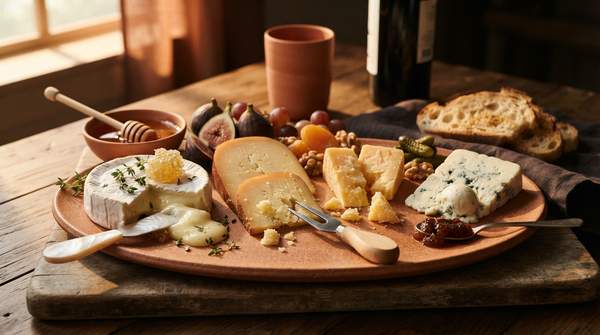
Your proof of success is visible before anyone tastes a bite: a cheese board featuring distinct textures and a clear progression of flavor intensities, ready for tasting. If you can point to a creamy bloomy rind, a sliceable semi-hard, a crystalline aged wedge, and a veined blue — and they're arranged mild to bold at room temperature — you've built it right.
Sources
- Artisan Cheese Board Guide — Cheese Grotto
- Types of Cheese: The 7 Main Kinds, Explained — John Eats Cheese
- What Is Artisan Cheese? A Guide to Flavor & Craft — Gardners Wisconsin Cheese and Sausage