Choosing a food tour in Mexico comes down to matching the format to your travel style. Across the major culinary destinations—Mexico City, Oaxaca, Guadalajara, and Puebla—offerings cluster into three distinct types: street food crawls, market explorations, and private tasting tours. Each delivers a different balance of culinary focus, cultural immersion, and group dynamics, and the right choice depends less on "best" than on what kind of eater and traveler you are.
Choosing Your Culinary Adventure: An Overview of Mexican Food Tours
Mexican cuisine is deeply regional, as the tour aggregator TourRadar notes: what you eat in Oaxaca differs completely from Guadalajara or the Yucatán, with mole in Oaxaca, mole poblano in Puebla, cochinita pibil in the Yucatán, and fish tacos and wine in Baja. That regional variety is why tour formats vary so much. A street crawl in Mexico City's Roma neighborhood, a chef-led walk through a mercado, and a private ten-tasting circuit in Oaxaca are fundamentally different products, even when all three promise "authentic" food.
One TourRadar reviewer, Gemma, who traveled in December, described how these formats can combine: hands-on cooking classes, chef-led market tours, and street food crawls, balanced with mezcal distilleries and artisan workshops for what she called "a complete cultural immersion." The framework below breaks the three core types into the factors that actually drive a booking decision.
Mexican Food Tour Comparison: Street, Market, and Private Experiences
Use this table to locate your travel style before reading the detailed sections. The reasoning is straightforward: each tour type is defined by who it suits, what it actually involves, how many people you'll share it with, and how much the route can bend to your interests.
| Tour Type | Best For | Typical Experience | Group Size | Customization |
|---|---|---|---|---|
| Street Food Crawls | Travelers seeking authentic local flavors and a vibrant, immersive cultural experience | Multiple street food stops with tastings and cultural commentary; one example runs 6 stops over 3–3½ hours | Small groups, often capped around 12 people | Limited—routes are curated to specific neighborhoods and stalls |
| Market Explorations | Those interested in the origins of Mexican cuisine, ingredients, and deeper cultural understanding | Guided walks through markets such as San Juan, learning about ingredients; sometimes paired with cooking classes or tastings | Small groups emphasized for a personalized, non-touristy experience | Varies by operator |
| Private Tasting Tours | Travelers wanting a personalized, flexible, in-depth experience shaped around their preferences | Tailored tastings with a dedicated host; one Oaxaca format offers 10 sweet-to-savory tastings plus drinks over roughly 3 hours | Private group—just you and your own travel companions | High—hosts adjust stops, pace, and focus on request |
The comparison yields a clear decision boundary: if you want energy and street-level immersion at a set route, choose a crawl; if you want to understand ingredients and traditions, choose a market walk; if you want the itinerary shaped around you, choose a private tasting tour.
Street Food Crawls: Dive into Local Flavors
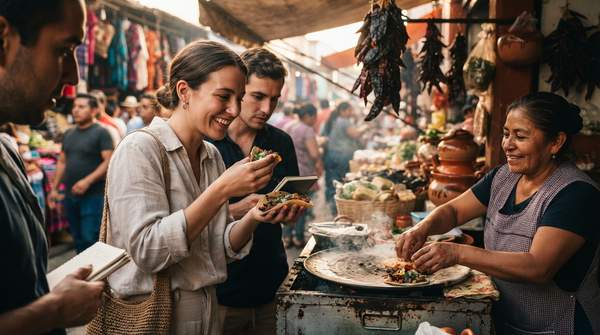
Street crawls are the most kinetic of the three formats. Secret Food Tours' Mexico City offering journeys through "all facets of Mexican cuisine, from 'Grandma's' kitchen, keeping alive traditional recipes," running 3 to 3½ hours through the Old Town with 6 stops and a maximum of 12 people. The company frames its Roma neighborhood route as a way to gain "a better understanding of our culture" while sampling authentic styles of Mexican cooking.
The small-group cap matters here: operators keep numbers low specifically to avoid touristy spots and deepen immersion. Eat Mexico, which runs street and market tours in Mexico City and Puebla, says it deliberately avoids tourist traps and keeps group sizes small so guests "can experience Mexico how locals do." For a first-timer, a listing roundup by Léo Carpentier at Pixidia points to a Roma Norte food tour as a strong entry point—it carries 1,382 reviews with a 4.97 rating over 3.5 hours of tasting, making it the most-reviewed option in that roundup.
Market Explorations: Beyond the Plate
Market tours trade the crawl's momentum for depth. TourRadar's overview positions them as exploring markets with locals, often chef-led, and frequently paired with cooking classes—making mole in Oaxaca, for instance. The educational payoff comes from guides with formal training: Eat Mexico says its guides "have studied Mexican gastronomy formally and have hands-on experience working in kitchens," and have drawn five-star reviews for over ten years.
A past guest's account, published on Eat Mexico's site, illustrates what that looks like in practice. Returning for mercado and Nápoles (Roma) tours after a first visit in November 2023, the reviewer praised guide Toti as "always a great resource for culinary and cultural questions," and described the San Juan market with guide Ariane as "a perfect introduction to the best places to eat in Centro"—including an al pastor taco the reviewer called standard-setting, plus concrete knowledge of where to buy ingredients and gourmet gifts. That is the market tour's distinctive value: you leave knowing where the food comes from and where to find it again.
Private Tasting Tours: Tailored Gastronomic Experiences
Private tours invert the group model entirely. WithLocals, which offers food tours in Mexico City, Oaxaca, and Guadalajara, describes its format as "just for you. No strangers, no groups"—you experience the city one-on-one or with your own travel group, with "no rushing, no scripted group tours." The customization is explicit: hosts adjust everything to fit your wishes, whether that means skipping a stop, adding a food stop, or shifting focus, and you can message the host directly before booking to ask questions or make requests.
Concrete examples show the format's range. WithLocals' "The 10 Tastings of Oaxaca" offers ten typical tastings from sweet to savory plus drinks for €61 per person, while "The 10 Tastings of Guadalajara" runs about 3 hours with a foodie host and carries 58 reviews. Pixidia's roundup, meanwhile, flags a private cooking class in San Ángel as the highest-rated experience in its Mexico City list at 5.00—albeit on a smaller base of 130 reviews—showing that private formats extend beyond walking tours into hands-on instruction.
Essential Logistical Factors for Booking Your Tour
Three practical checks will save most booking headaches. First, lead time: Pixidia's guidance warns against booking without checking the confirmation delay, since confirmation is not always instant—verify the lag before committing to a near-term date. Second, cancellation flexibility: Eat Mexico allows cancellation up to 48 hours before a tour begins for a full refund, a policy worth comparing across operators before you pay. Third, price versus duration: a three-hour class and a ten-hour day are not comparable at the same price, so always read the time commitment alongside the cost.
Two further caveats apply. Prices and availability change, so verify current figures directly with the operator—the €61 Oaxaca figure above is a listed snapshot, not a guarantee. And remember that per-person prices may not be the full cost; factor in tips when budgeting. The tours named here are illustrative examples from major destinations, not an exhaustive or ranked list.
Making Your Choice: What to Consider Before Booking
Travelers should select a food tour type and operator based on their desired culinary focus, level of cultural immersion, preferred group size, and need for customization, while also considering practical logistics like booking lead times and cancellation policies. In practice: choose a street crawl for lively, small-group immersion at a fixed route; a market exploration for ingredient-level understanding with gastronomy-trained guides; or a private tasting tour for a tailored itinerary with no strangers attached.
The measurable indicator of success is simple: the traveler successfully books a food tour that matches their preferences and avoids common booking pitfalls. Before you confirm any booking, check the confirmation lead time, the cancellation window, and whether the price matches the duration—then verify the current price with the operator directly.