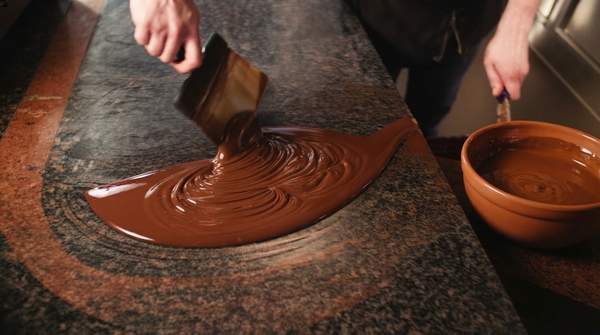
Every chocolate type demands its own three-stage temperature curve, and the reason is chemistry: the proportion of cocoa butter, cocoa solids, and milk fat in the bar determines how its cocoa butter crystallizes. Dark chocolate is tempered warmest—melted to 45–50°C, cooled to 27°C, then worked at 31–32°C—while milk, white, and ruby chocolates, softened by milk fat, must be worked two to three degrees cooler. Follow the right curve for your ingredient and the reward is the same: a glossy surface, a clean snap, and a confection that resists streaks and bloom.
Introduction: The Science of a Perfect Snap
Tempering is the controlled heating and cooling of melted chocolate so that its fat sets in a stable crystal form rather than a disorderly one. As Ghirardelli's confectionery experts put it, proper tempering "gives chocolate a smooth and glossy finish, keeps it from easily melting on your fingers, and allows it to set up beautifully." The chocolate maker Valrhona adds that good tempering keeps chocolate shiny, eases release from molds, and produces that clean snap pastry cooks prize. The catch is that one universal curve does not exist: dark, milk, white, and ruby chocolates differ in fat and solids composition, so each requires different temperatures at the melt, cool, and working stages. Precision matters, and a candy thermometer—avoiding anything above about 130°F, where chocolate scorches or seizes—is the essential tool.
Understanding Chocolate Composition: The Key to Tempering
All chocolate begins with the cacao bean, which is processed into cacao nibs, the solids that carry flavor and color, and cacao butter, the fat that carries structure. As chocolatier Mackenzie Rivers explained to Perfect Daily Grind, "in order to be chocolate, the product must contain cacao in some form"—a definition that embraces white and ruby varieties even though they contain little or no dark cacao mass.
A comparative study published in the journal Processes in 2024 quantified how the varieties diverge: in the samples analyzed, dark chocolate contained 70% cocoa content with fat derived solely from cocoa butter, while milk chocolate carried 33% cocoa content, white chocolate 28%, and ruby chocolate 47%, with the milk, white, and ruby varieties each containing 36% fat from a blend of milk fat and cocoa butter. Those compositional differences, the study concluded, exerted the strongest influence on each chocolate's thermal, rheological, and textural behavior—exactly the properties a pastry cook manipulates during tempering.
The Role of Cocoa Butter Crystallization
Cocoa butter is polymorphic: it can solidify into several distinct crystal forms, and only one of them behaves well. Tempering exists, as the 2024 Processes study explains, to force the fat into the desirable Form V, which melts at 32–34°C and delivers the optimal gloss, firmness, shrinkage for molding, and shelf life that confectioners want. Melted, untempered chocolate holds no crystal memory, so if it simply cools on its own, the fat locks into whatever mixture of forms chance produces—soft, dull, streaked with bloom.
The tempering process works by first melting away every existing crystal, then cooling the chocolate to a point where stable Form V seeds can form, and finally warming it slightly so those stable seeds multiply while the unstable forms melt out. Each chocolate type tolerates a different window at each stage, which is why a chart, not a single number, governs the craft.
Dark Chocolate: High Cocoa Solids, Higher Temperatures
Dark chocolate is structurally the simplest case: its fat phase is essentially pure cocoa butter, and its cocoa content is the highest of the four types—70% in the study's sample, and legally regarded as dark when above 50% cocoa solids. With no milk fat softening the crystal network, dark chocolate follows the warmest curve of the four. Callebaut's crystallization chart for its 811 dark couverture specifies melting to 45–50°C (113–122°F), cooling to 27°C (80.6°F), and warming back to a working temperature of 31–32°C (87.8–89.6°F), with a maximum working temperature of 34.5°C. Valrhona's guidance runs slightly warmer on the melt, placing dark chocolate at 50–55°C (120–130°F)—a reminder that specific couverture formulations vary by brand and cocoa percentage. The wide melt range exists to guarantee every last cocoa butter crystal is dissolved before cooling begins.
Milk and White Chocolate: The Impact of Milk Solids
Milk and white chocolate share the feature that reshapes their tempering curves: milk fat. The Processes study notes that milk fat softens the chocolate's crystalline structure and alters the melting properties of the finished product; milk fat is itself polymorphic, crystallizing into γ, α, and β′ forms. Because this softer fat is blended with the cocoa butter, the whole network wants to crystallize at slightly lower temperatures, and exceeding the working temperature destroys the temper. Both chocolates therefore melt cooler than dark—around 45°C (113°F)—and work cooler too.
Callebaut's figures put milk chocolate (its 823 couverture, 33% cocoa content in the study's comparable category) at a working temperature of 29–30°C (84.2–86°F) and white chocolate at 28–29°C (82.4–84.2°F), both cooled to 27°C first. White chocolate, which in the study's samples contained 28% cocoa content—essentially cocoa butter with milk solids and sugar, no dark cacao mass—sits at the gentlest end of the range.
Ruby Chocolate: A Unique Composition and Tempering Curve
Ruby chocolate, the pink variety introduced in recent years, occupies a middle ground in composition: the 2024 study measured 47% cocoa content in its sample—well above milk and white chocolate but far below dark—with its 36% fat content drawn from both milk fat and cocoa butter. That hybrid composition gives it a tempering curve close to milk chocolate's but with its own fine tolerances. Callebaut specifies melting to 45°C (113°F), cooling to 27°C (80.6°F), and working at 28.5–29.5°C (83.3–85.1°F), with a maximum working temperature of 32°C (89.6°F). The same principle applies as with the other milk-fat chocolates: the softer fat blend demands gentler handling than dark couverture, and the narrow half-degree working window rewards a reliable thermometer.
Tempering Temperature Guide for Different Chocolate Types
The table below correlates each chocolate's compositional profile with its three-stage tempering temperatures, drawn from Callebaut's crystallization curves. Read across a row to follow one chocolate from melt to cool to working temperature; read down a column to see how milk fat progressively lowers the working range.
| Chocolate | Key Compositional Difference | Melt To | Cool To | Warm To (Working) |
|---|---|---|---|---|
| Dark (e.g., 70% cocoa) | Highest cocoa solids; fat phase solely cocoa butter | 45–50°C / 113–122°F | 27°C / 80.6°F | 31–32°C / 87.8–89.6°F |
| Milk | Cocoa solids plus milk solids; fat blend of milk fat and cocoa butter | 45°C / 113°F | 27°C / 80.6°F | 29–30°C / 84.2–86°F |
| Ruby | 47% cocoa content with milk fat; softer crystal network | 45°C / 113°F | 27°C / 80.6°F | 28.5–29.5°C / 83.3–85.1°F |
| White | Essentially no cacao mass; cocoa butter, milk solids, sugar | 45°C / 113°F | 27°C / 80.6°F | 28–29°C / 82.4–84.2°F |
Treat these figures as guidelines rather than absolutes: couverture brands vary in cocoa percentage and formulation—Valrhona, for instance, melts dark chocolate at 50–55°C—and ambient kitchen conditions shift results slightly. These curves apply to seeding and bain-marie methods suited to the home kitchen, not industrial tempering machines, and not to compound chocolate or gold/blonde varieties, which are outside this guide's scope.
Achieving a Professional Finish: Your Tempering Success
To temper successfully, match your process to your ingredient: melt dark chocolate to 45–50°C and work it at 31–32°C, but hold milk, white, and ruby chocolates to gentler curves because their milk fat softens the crystal network and demands lower working temperatures. Use a candy thermometer throughout, keep every trace of water away from the bowl, and never exceed the maximum working temperature for your type—34.5°C for dark couverture, about 31.5°C for milk and white, 32°C for ruby. The result you are aiming for is measurable: the tempered chocolate exhibits a glossy finish, a firm snap when broken, and no visible streaks or bloom. If streaks or a soft, bendable set appear instead, the temper failed—and the fix is to remelt fully and run the correct curve again.
Sources
- Tempering Chocolate Tips & Melting Chocolate Techniques — Ghirardelli
- Tempering chocolate — Valrhona
- Dark, Milk, White... & Ruby? The Different Chocolates Explained — Perfect Daily Grind
- MDPI
- Guide to Different Tempering Methods — Callebaut