Every egg dish you make is really a protein-engineering project. When you cook an egg, you're not just applying heat—you're persuading its proteins to abandon their tidy, coiled shapes and rebuild themselves into entirely new structures. That transformation, called denaturation, is the single scientific event behind a silky custard, a tender scramble, a runny yolk, and a fluffy meringue. Understand it, and you gain real control at the stove.
Here's the core idea: egg proteins start folded into tight, three-dimensional units held together by loose bonds. Disturb those bonds—through heat, acid, salt, alkali, or sheer physical force—and the proteins unravel. Once unraveled, their exposed surfaces bond with one another, forming a network. That network is what turns liquid egg into something you can chew.
The Science of Egg Cooking: Understanding Protein Denaturation
I love this part, because "denaturation" sounds intimidating but the concept is wonderfully literal—it means "changing the nature" of a protein. As the Exploratorium's science-of-cooking writers put it, denaturation "happens when protein molecules unravel from their naturally coiled state."
With eggs, this unravelling happens most often when they're heated or beaten, but it can also be prompted by salt, acids such as vinegar, alkalies such as baking soda, and even freezing, according to the same source. The American Egg Board, writing for food formulators, describes the same physics from an industry angle: loose bonds across each protein's folds and coils hold it in a tight, separate unit, and those bonds break when exposed to heat, acid, or whipping.
So the practical takeaway for a home cook: there isn't one way to "cook" an egg. There are several levers, and you can pull them in combination. A well-made meringue uses mechanical force. A poached egg leans on heat and, traditionally, a splash of acid. Once you see the levers, you can start choosing them deliberately.
How Proteins Unfold: From Coils to Networks
Picture a protein as a coiled spring, wound up and held in place by weak little clasps. Something—an oven, a hot pan, a whisk—pops the clasps. The spring relaxes into a long, loose strand.
That strand is where the texture magic happens. As the Exploratorium explains, when protein molecules are heated, they unfold and extend, and their surface area increases. The newly exposed parts of the molecules become receptive to bonding with other protein molecules, and a network of cross-bonds forms. The result is clumping—and with it, solidity.
The nutrition educators at LibreTexts describe the same sequence: an egg protein in a changed environment unfolds into a single strand of amino acids, and the unraveled strands then stick together, forming an aggregate or network. This is why cooking is gradual and reversible-looking from the outside: raw, then soft, then hard. Each stage is just a more complete network.
Heat: The Primary Driver of Egg Coagulation
Heat is the denaturation agent most of us reach for first, and it's the one behind boiling, frying, poaching, and baking. When an egg hits a hot pan, its proteins unfold, extend, bond to their neighbors, and progressively clump—the molecular version of an egg going, in the Exploratorium's phrase, "from raw to soft to hard."
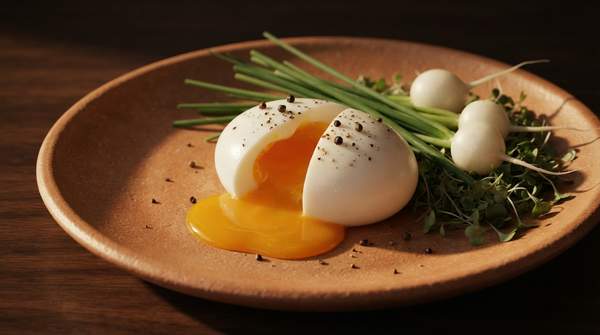
What makes this useful rather than just interesting is that different parts of the egg behave differently under the same heat. That's why a soft-boiled egg exists at all: the white can set while the yolk stays fluid, because their proteins don't coagulate on identical schedules. Time in the heat is the second half of the equation—more heat exposure means more complete networks, and firmer texture.
The American Egg Board adds a wrinkle formulators care about: sugar raises the temperature at which coagulation occurs. That's why a custard containing sugar behaves gently and gradually rather than snapping from liquid to rubber. You're engineering the conditions under which the protein network forms.
Mechanical Force: Whipping Up Texture
Heat isn't the only way to denature egg proteins—whisking is physical denaturation, no stove required. According to the American Egg Board, bonds holding a protein in its tight, separate unit can be disrupted by physical means such as whipping, causing the protein to denature.
This is the science of the meringue. Beat egg whites and you're mechanically unfolding their proteins, exposing bonding surfaces, and building a network—except this one is a foam: a scaffold of unfolded proteins wrapped around air. The more vigorously and consistently you beat, the more thoroughly you denature, and the stiffer the structure you build.
Notice what this means: the same molecule can become a rubbery boiled white or an airy foam, depending entirely on which denaturation agent you apply. The protein doesn't care about the recipe. It responds to conditions.
Chemical Allies: Acids, Salt, and Alkalies
Now for my favorite levers—the ones hiding in your pantry. Acids such as vinegar cause egg proteins to denature, according to both the American Egg Board and the Exploratorium. The American Egg Board adds a specific practical effect: acids decrease the temperature where coagulation is achieved. That's the real reason a splash of vinegar goes into poaching water—it helps the outer white set quickly, so the egg holds together instead of feathering into wisps.
Alkalies, such as baking soda, can also denature egg proteins, the Exploratorium notes, and the American Egg Board observes that a high alkali level can induce gelling of egg white. On the other side of the ledger, salt also prompts denaturation, and sugar—while not a denaturer itself—raises the coagulation temperature, buying you gentler, more forgiving cooking in sweet egg dishes.
Freezing, the Exploratorium adds, is yet another route to denaturation. The lesson: proteins respond to their environment, and "environment" includes far more than your burner's setting.
Egg Texture Control: Denaturation Agents and Outcomes
Here's the model I want you to carry into the kitchen. Each row is a lever you can pull; the last column is what you'll see on the plate. Use it to work backwards from the texture you want to the technique that produces it.
| Denaturation Agent | Mechanism of Action | Protein Transformation | Resulting Texture / Application |
|---|---|---|---|
| Heat | Proteins unfold and extend; exposed surfaces bond with other molecules | Unraveled strands form a cross-bonded network, causing clumping | Sets liquid egg: soft to firm whites, set yolks (boiling, frying, poaching) |
| Mechanical force | Whipping or beating disrupts the bonds holding proteins in tight units | Proteins denature without heat and rebuild around incorporated air | A common route to foams; stiff meringue-style structures |
| Acids (e.g., vinegar) | Chemical means of inducing coagulation | Proteins unravel and coagulate at a lower temperature | Faster-setting whites; traditional poaching aid |
| Alkalies (e.g., baking soda) | Chemical means of altering protein structure | High alkali can induce gelling of egg white | Altered gel textures in egg mixtures |
| Salt | Also prompts denaturation, per the Exploratorium | Proteins unravel from their coiled state | Texture modification in seasoned egg dishes |
| Sugar (modifier) | Raises the temperature at which coagulation occurs | Delays the unfolding-and-bonding process | Gentler, more gradual setting in custards and sweet egg dishes |
Two honest boundaries on this map: the evidence here doesn't give exact temperatures for each doneness stage—this is a framework for understanding direction and cause, not a precision chart. And it doesn't address how cooking changes eggs nutritionally. Those are separate questions.
Achieving Desired Egg Textures
To consistently achieve desired egg textures, home cooks should consciously manipulate heat, mechanical action, and chemical additives based on their understanding of protein denaturation. In practice that means deciding the destination first: a tender scramble means gentle heat and early removal, because the network keeps forming from residual warmth; a stable meringue means thorough mechanical denaturation; a tidy poached egg means acid in the water and moderate heat.
Your checkable outcome is simple: whether the visual and tactile consistency of the cooked egg—runny, firm, fluffy, or crumbly—matches the intended result for the dish. When it doesn't, run through the model. Ask which lever you actually pulled, and which one you meant to. That diagnosis, more than any timer, is what turns egg cooking from luck into skill.