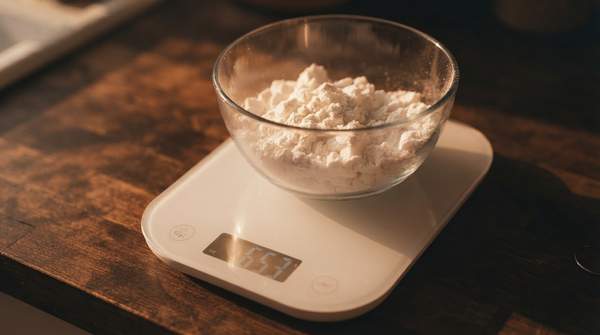
The honest answer to "what's the best kitchen scale for baking?" is that there isn't one—there's a best scale for you. If you bake bread in heavy mixing bowls, you need capacity. If you fuss over yeast and salt in small-batch pastry, you want 0.1-gram precision. And if you've ever had a scale blink off mid-recipe, you know auto-off time matters more than any spec sheet suggests.
Based on recommendations and testing notes from Bon Appétit, Wirecutter, and America's Test Kitchen, three scales stand out for different reasons: the Escali Primo, the Ozeri Pronto, and the OXO Good Grips food scale. None of them wins every category. What follows is the comparison, the reasoning, and the decision framework—so you can figure out which one belongs on your counter.
Key Features to Consider When Choosing a Baking Scale
Start with why you're weighing at all. Volume measurement is unreliable in baking, and the swings are big. As Wirecutter reports, Alton Brown puts a cup of flour anywhere between 4 and 6 ounces depending on the age of the flour, the relative humidity, and how the baker scoops. That's not a rounding error—that's the difference between a light, ethereal cake and a dense, rubbery one.
Pastry chef Briana Holt, quoted by Wirecutter, frames it as empowerment: "Accuracy is one of the keys to feeling empowered when baking at home." Her advice for home cooks is simple: "Find a scale, and look for recipes written in weights." Once you've taken that advice, four features do most of the deciding for you.
- Maximum capacity. This is the ceiling the scale can read before it errors out—and remember, the bowl counts too. An 11-pound capacity, which Bon Appétit found on the Escali Primo, is "large enough to accommodate any task a home cook might ask of it." Bread bakers pushing heavy dough into big stoneware or ceramic bowls should pay the closest attention here, because a scale that maxes out mid-weigh is useless for exactly the job you bought it for.
- Precision. This is the smallest increment the scale displays. A 1-gram scale is fine for most recipes; a 0.1-gram (decigram) scale like the Ozeri Pronto reads ten times finer. Wirecutter's testers point out that decigram measurement is something "most home cooks don't need"—but they pair that with the observation that the Ozeri is "nearly as accurate" as their favorite pocket scale. So the finer readout is a capability question, not a quality one: it only pays off when you're portioning potent ingredients in tiny amounts.
- Auto-off time. Every scale powers itself down to save battery. The catch: if it shuts off while you're slowly adding flour to a bowl, you lose your running measurement and start over. Bon Appétit highlights the Escali's 4.5-minute auto shut-off as "among the longest of any model we tested, so you won't lose your measurements mid-bake." Wirecutter, for its part, found its own pick's four-minute auto-off "provided enough time to weigh ingredients"—which tells you four minutes is roughly the practical floor, and anything shorter starts to bite.
- Display and cleanability. A wide mixing bowl can swallow the readout. The Escali solves this with an elevated, offset weighing platform—you can read the display and use the buttons even when measuring into a large, wide bowl, per Bon Appétit. OXO's answer is a screen that pulls out an extra four inches, as America's Test Kitchen describes. On the cleanup side, the Escali's plastic body and sealed control panel wipe down easily and keep stray crumbs out of crevices, while the OXO's stainless-steel weighing platform is removable.
Kitchen Scale Comparison for Bakers
Here's the side-by-side view. The specs come straight from the reviews, so you can see the trade-offs at a glance: the Escali buys you time and bowl clearance, the Ozeri buys you capacity and finer resolution, and the OXO buys you visibility and cleanup. No single model wins every column—that's the point of comparing them.
| Model | Max Capacity | Precision | Auto-Off | Key Differentiator |
|---|---|---|---|---|
| Escali Primo | 11 lb | 1 g | 4.5 minutes — among the longest tested by Bon Appétit | Elevated, offset platform stays readable under large mixing bowls; sealed plastic body wipes clean easily |
| Ozeri Pronto | 13 lb (5.9 kg) | 0.1 g (decigram) | Shorter than the Escali's, per Wirecutter | Delivers the same level of accuracy as Wirecutter's top pick, with greater capacity and finer measurement |
| OXO Good Grips | Not specified in the cited reviews | Not specified in the cited reviews | Not specified in the cited reviews | Pull-out display extends four inches for big bowls; removable stainless-steel platform; durability proven by years of daily test-kitchen use |
A few cells in the OXO row are blank, and that's worth being upfront about: the cited sources that praise the OXO's design and durability don't state its capacity, precision, or auto-off timing in the passages referenced here, so I won't guess. Check the box or spec sheet before buying if those numbers drive your decision.
Read the table as a decision surface, not a scoreboard. Going across the rows: the Escali and Ozeri are separated by two pounds of capacity, a factor of ten in resolution, and a meaningfully different auto-off clock. The OXO competes on a different axis entirely—ergonomics and longevity—since America's Test Kitchen stocks dozens of them in its test kitchen and its writer reports using a personal copy daily for years, through "countless drops, knicks, and splashes."
Matching Scale Features to Your Baking Style
If you're a bread baker: prioritize capacity and a long auto-off
Bread is where capacity earns its keep. Add up a heavy mixing bowl, a kilogram or more of flour, water, and starter, and the total climbs fast—and anything over the scale's ceiling simply fails to register. The Escali's 11-pound ceiling covers what Bon Appétit calls any home-cook task; the Ozeri's 13 pounds (5.9 kilograms) gives you extra headroom for bigger batches or heavier bowls.
Time matters just as much here. Bread formulas involve sequential additions—water, flour, starter, salt—sometimes with pauses while you knead or rest between weigh-ins. Wirecutter found four minutes gave its testers enough time to weigh ingredients, but flagged the Ozeri's shorter timer as a drawback relative to its top pick. The Escali's 4.5 minutes is your insurance against a reset at the worst moment.
If you're a precision baker: decide honestly whether you need 0.1 grams
Here's the question Wirecutter raises but doesn't fully resolve for you: do you need decigram precision? Their testers say most home cooks don't. Where it genuinely helps is small quantities of potent ingredients—yeast, salt, chemical leaveners—where a fraction of a gram can shift hydration or fermentation in small-batch or scaled-down formulas. A 1-gram scale reading "close enough" on two grams of yeast is a coin flip; a 0.1-gram scale tells you what you actually have.
But note the distinction: the Ozeri isn't a more accurate scale—it's the same accuracy with a finer readout, per Wirecutter. If you mostly weigh cups-into-grams flour and sugar for cookies, cakes, and everyday loaves, 1-gram resolution is plenty, and paying for decigrams buys precision you'll never use.
If you bake with big bowls: check the display before anything else
Both Bon Appétit and America's Test Kitchen zeroed in on the same daily annoyance: a wide bowl hides the screen. The Escali's elevated, offset platform keeps the readout and buttons reachable even when measuring into a large, wide mixing bowl. OXO's pull-out display extends four inches to solve the same problem differently. Either approach works; what doesn't work is squinting at a number you can't see, every single bake.
If mess is your reality: think about cleanup
Flour gets everywhere. The Escali's sealed control panel means no crumbs in the crevices, and Bon Appétit calls the wipe-down "a breeze" after a floury session. The OXO's platform lifts off entirely, which America's Test Kitchen says makes cleaning the unit "a breeze" in its own words. Both are low-friction options; the choice here is really about which display solution you prefer.
Choosing Your Ideal Baking Baking Scale
Here's the decision in one sentence: select a kitchen scale by prioritizing either high capacity for large-batch baking, 0.1-gram precision for sensitive ingredients, or convenience features like a long auto-off time and pull-out display based on your primary baking style. Concretely: bread bakers get the most from the Escali Primo's 11-pound capacity and 4.5-minute auto-off, or the Ozeri Pronto's 13-pound ceiling if they want room to grow. Precision workers want the Ozeri's decigram readout. Everyday bakers who value a visible screen, easy cleanup, and proven durability lean OXO—after confirming its capacity and precision meet their needs from the spec sheet.
How do you know you chose well? The measure is practical, not abstract: the chosen scale consistently provides accurate measurements for your most common baking tasks, and its features—auto-off timing, display visibility—never interrupt your workflow. Run your next three bakes with the new scale. If you never lose a measurement to a premature shut-off, never squint at a hidden screen, and never max out the capacity, you picked the right one.
Sources
- This Kitchen Scale Has Been With Our Senior Test Kitchen Editor for Over a Decade — Bon Appétit
- The Best Kitchen Scale — Wirecutter: Reviews for the Real World
- The Kitchen Scale That Will Improve Your Cooking — America's Test Kitchen