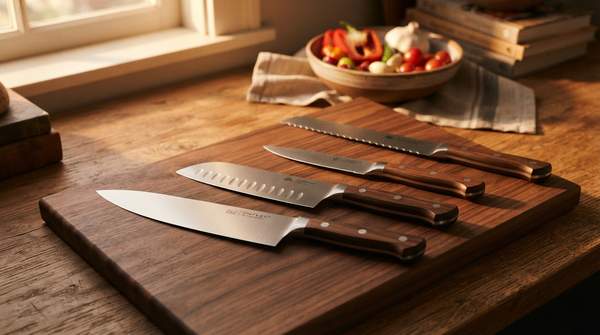
Here's the short answer: most home cooks need three knives, and almost nobody needs more than five. A chef's knife, a paring knife, and a serrated knife cover the overwhelming majority of everyday cooking, with a utility knife and a santoku as useful additions depending on how you cook. Knife retailer Imarku's guide puts it plainly—if you could keep only one kitchen knife, a chef's knife would be the practical place to start—and chef Julie Yoon agrees that with one reliable chef's knife, "you don't need much else."
But knowing which knives to buy is only half the decision. The other half is what each knife is made of, how it feels in your hand, and how much care it demands. That's where this guide comes in: a side-by-side comparison of the five essentials, plus the material and handle trade-offs that determine whether a knife is a pleasure to use for years or a drawer-bound regret.
Introduction: The Foundation of Your Home Kitchen
A kitchen doesn't need a huge knife collection. It needs a few reliable blades that handle the tasks you actually perform most often—chopping vegetables, slicing meat, preparing fruit, cutting bread. Some knives are versatile enough for daily meal prep, while others exist to make specific jobs safer, easier, and more precise. The trick is matching the knife to your habits rather than accumulating blades for their own sake.
Both the manufacturer guides and the working chef I consulted converge on the same core insight: start with a versatile chef's knife, then add specialized tools around it. A santoku, utility knife, paring knife, and bread knife each serve different purposes, letting you handle a wider range of ingredients with more control. This guide is for general-purpose home cooking—not butchery, not sushi—and I won't push specific brands or models, just the features worth paying attention to.
Essential Knife Types for Every Home Cook
The chef's knife is the workhorse. It's built for chopping, slicing, dicing, and mincing across a wide variety of ingredients, and it's consistently identified as the single most essential knife for general kitchen tasks. If your budget only stretches to one good blade, this is the one.
The paring knife is the precision instrument. Its small size allows for delicate work where a larger knife would be unwieldy—peeling, trimming, coring, and intricate cuts on fruits and vegetables. Yoon also highlights it for scoring, scooping, and detail work.
The serrated knife, often called a bread knife, uses a saw-like action to slice through soft items without crushing them. The serrations prevent tearing and allow clean cuts on things with delicate exteriors and soft interiors: bread, tomatoes, pastries. Yoon calls it a "convenience" knife—but one that will do a better job than a chef's knife for certain jobs.
The utility knife sits between the chef's and paring knife in size, handling mid-sized tasks where a chef's knife feels clumsy and a paring knife too small. The santoku, meanwhile, is a Japanese-style generalist excelling at thin, even slices of vegetables and boneless proteins—a popular alternative to the chef's knife for cooks who prefer its shorter, lighter profile.
Blade Materials: Performance and Maintenance Trade-offs
Blade material is where the real trade-offs live. Stainless steel is the popular choice for everyday kitchen knives because it offers corrosion resistance and is relatively straightforward to maintain. That's why it dominates mainstream home-knife lines. All-Clad, for instance, builds its forged knives from German stainless steel, enhanced through a cryogenic treatment the company says improves rust resistance and sharp-edge retention.
The general principle: stainless steel trades a bit of edge retention for corrosion resistance and easy care. Carbon steel, by contrast, holds a sharper edge longer but demands more diligent maintenance—it rusts and discolors if left wet or neglected. For most home cooks, the stainless trade is worth it; you give up a little peak performance for a blade that forgives being left in the sink.
Whatever steel you choose, sharpness, edge retention, and maintenance requirements should factor into the purchase alongside the knife type. A dull knife of premium steel is more dangerous and less useful than a sharp budget blade, so plan for ongoing care—honing regularly and sharpening when needed. Specific sharpening angles and techniques vary by knife and sharpener, so treat maintenance as a general principle rather than a fixed protocol.
Handle Ergonomics and Design
A knife should feel balanced and comfortable in your hand—this isn't a luxury, it's a control and safety issue. Consider the handle shape, material, grip, and overall weight before buying. A comfortable handle makes repetitive food preparation easier, especially when you're chopping or slicing multiple ingredients, and ergonomics are key for control during extensive use.
Handle materials vary. All-Clad uses a fade-resistant polyoxyethylene—POM for short—with triple-riveted construction, a choice the company says ensures comfortable control during extended prep sessions while holding its appearance over time. Wood and composite handles are also common, each with different feels and care needs. Wood looks beautiful but can degrade with moisture; synthetics like POM shrug off the dishwasher-adjacent realities of a busy kitchen.
Here's the honest part: personal preference plays a significant role in determining what feels comfortable and balanced for an individual. If you can, hold a knife before buying it. The "right" handle is the one that disappears in your grip during a long prep session, not the one with the best spec sheet.
Comparative Guide to Essential Kitchen Knives
Here's the at-a-glance comparison. Use it to match each knife's design to the tasks you actually cook—bread baker? The serrated knife is non-negotiable. Lots of fruit prep? Prioritize the paring knife.
| Knife Type | Primary Use Cases | Common Blade Materials | Handle Considerations |
|---|---|---|---|
| Chef's Knife | Chopping, slicing, dicing, and mincing a wide variety of ingredients; often considered the most essential knife for general tasks | Stainless steel (German stainless common in forged lines); carbon steel for better edge retention at the cost of more care | Designed for a comfortable, balanced grip—POM, wood, or composite; ergonomics are key for control during extensive use |
| Paring Knife | Small, precise tasks: peeling, trimming, coring, scoring, and intricate cuts on fruits and vegetables | Stainless steel for corrosion resistance and easy maintenance | Small, lightweight handle for delicate control where a larger knife would be unwieldy |
| Serrated (Bread) Knife | Saw-like slicing of soft items without crushing: bread, tomatoes, pastries | Stainless steel; serrations prevent tearing on delicate exteriors and soft interiors | Longer handle for two-handed sawing motion; grip security matters on crusty items |
| Utility Knife | Mid-sized tasks between a chef's and paring knife—sandwiches, small produce, jobs where either extreme feels clumsy | Stainless steel; sometimes serrated for tomatoes and soft items | Intermediate size; balance favors lighter, quicker handling |
| Santoku Knife | Thin, even slices of vegetables and boneless proteins; a popular chef's-knife alternative for everyday prep | Stainless steel, including Japanese-style steels emphasizing sharpness | Often lighter and shorter than a chef's knife; comfort depends on individual preference |
The comparison makes the trade-offs visible: stainless steel buys corrosion resistance and easy maintenance, while harder or carbon steels buy edge retention at the price of more diligent care. And the table shows which knife is designed for which job—bread versus vegetables, precision versus power—so you can skip the blades your cooking never touches.
Choosing Your Essential Knife Set
So how do you decide? Select knives based on your most frequent cooking tasks, prioritizing a comfortable handle and appropriate blade material for longevity and performance. Start with the chef's knife—it's the foundation—then add a paring knife and a serrated knife, which together handle nearly everything else. A utility knife or santoku earns its slot only if your cooking style genuinely calls for it: lots of sandwich-making, or a preference for the santoku's lighter slicing action.
Don't forget storage—proper storage protects knife edges and keeps your kitchen organized, whether that's a block, magnetic strip, or blade guards. And think long-term: a good knife purchased today can be a worthwhile investment for serious home cooks who value both performance and longevity, as All-Clad's own guidance notes. You don't need the largest collection to prepare great meals.
Your measurable indicator of success: a kitchen setup where the chosen knives feel balanced and efficient for daily food preparation, requiring minimal effort for maintenance. If your chef's knife glides through an onion without resistance, your paring knife peels an apple without fighting you, and your bread knife saws a crusty loaf without crushing it—while the blades stay sharp with only routine honing—you've built the right set. If any knife sits unused after a month of real cooking, that's your signal it never belonged in your kitchen.