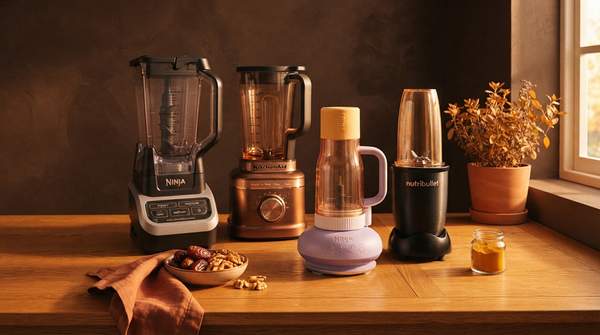
Here's the short answer before you read a single product review: the blender type you buy matters more than the model. If you mostly make single-serving smoothies, a personal blender is the right category. If you puree soup in the pot, get an immersion blender. If you want silky sauces and everyday versatility, a countertop blender is your match. And if nut butters, milling grains, or hot soup from raw vegetables are on your menu, you need a high-performance machine — starting around the $200 mark, according to Wirecutter's blender guide. Let's work through the framework.
Understanding Blender Categories: Immersion, Personal, Countertop, and High-Performance
Most kitchen guides, including Sage Appliances' blender-types overview, sort blenders into a handful of categories: personal blenders that are small, portable, and ideal for single servings; countertop blenders as great all-rounders with varying capacity and power; high-performance blenders for heavy-duty blending and diverse recipes; and immersion blenders, which let you mix quickly without a separate jar. (There's also the "bluicer," a blend-and-juice hybrid, but it's a niche option.)
Why start with the category? Because the biggest mistakes happen at this step. Buy a personal blender when you actually cook for a family, or a budget countertop model when you dream of almond butter, and no brand will save you. Match the type first, then compare models inside it.
The Power Behind the Blend: How Wattage and Design Impact Performance
Wattage isn't marketing fluff — it's the engine. A blender's wattage powers the motor that spins the blades fast enough to break down whatever you put in, as Green Gooding's wattage guide puts it: the harder the ingredients, the more torque you need, and torque comes from watts.
The practical difference is dramatic. A 300-watt personal blender can liquefy a ripe banana into yogurt, but it cannot turn frozen mango and kale into a smooth drink without leaving what that guide memorably calls a "green-fleck slush." A high-wattage blender breaks down ice and frozen fruit in 20–30 seconds; a low-wattage one takes 2–3 minutes and still leaves chunks.
Task-specific thresholds matter too. Zwilling's product guide recommends 600–800 watts if you regularly chop ice or frozen fruit, and 1,000 watts or more for grinding nut butter and flour. Daewoo's buying guide adds that around 1200W is where one blender starts to cover nearly everything — frozen fruit, ice, thicker mixtures, and family-sized batches — helped by a proper jug that gives ingredients room to move.
Choosing Your Blender: A Comparative Framework
Here's the side-by-side view. One note: the wattage and capacity figures below come from Green Gooding's published guide, and immersion blender specs aren't consistently reported in the sources I drew on — so treat that row as functional guidance rather than hard numbers.
| Blender Type | Typical Wattage | Container Capacity | Best For | Key Strengths | Limitations |
|---|---|---|---|---|---|
| Immersion | Not consistently specified | N/A (blends in your own pot or cup) | Pureeing soups directly in the pot; quick sauces like mayonnaise | Convenient, jar-free quick mixing | Less powerful than countertop models; can't match their velvety texture |
| Personal | 200–400 W | 12–24 oz | Smoothies, protein shakes, salad dressings | Portable; travel cup doubles as the blending container | Leaves chunks in frozen fruit and kale; not for hot liquids or big batches |
| Countertop (standard) | 500–900 W | 48–64 oz | Purées, cooked soups, sauces, basic smoothies | Versatile; holds more; handles hot liquids | Not built for nut butters or milling |
| High-performance | 1,400–2,400 W | 64–96 oz | Nut butter, almond flour, ice crushing, hot soup from raw veg | Most power, smoothest textures, widest task range | Typically starts around $200, per Wirecutter |
The pattern to notice: power and capacity rise together, and each step up unlocks tougher tasks. A mid-range countertop machine — roughly 1,000–1,500 watts in Green Gooding's tiering — handles frozen drinks, leafy-green smoothies, and even light nut butter, which is why that guide calls it the sweet spot for most home cooks.
Immersion Blenders: Quick Mixing and Direct Pureeing
Also known as stick blenders, these handheld tools are the only category that skips the jar entirely. That's their superpower: Wirecutter notes they're great for pureeing soups directly in the pot or making a quick mayo, sparing you the scalding transfer from pot to pitcher.
But there's a ceiling. Wirecutter is blunt that an immersion blender doesn't yield the velvety textures you get from a good countertop blender — a comparative limitation, not an inability to blend. Think of it as your soup-and-sauce specialist: low counter footprint, minimal cleanup, modest muscle.
Personal Blenders: Convenience for Single Servings
If your blending life is mostly a morning smoothie for one, this is your lane. Personal blenders are small and portable, and they typically come with a travel cup that doubles as the blending container — blend, swap the lid, walk out the door. Green Gooding's table lists their sweet spot as smoothies, protein shakes, and salad dressings, in a 12–24 oz cup driven by 200–400 watts.
The trade-off is exactly what that wattage implies. Green Gooding's own illustration — a 300-watt machine turning out green-flecked slush instead of smoothie — captures it. Frozen fruit and raw kale may emerge with chunks. And these machines are generally not designed for hot liquids or large batches. One or two servings, soft-ish ingredients: perfect.
Countertop Blenders: Versatile All-Rounders for Everyday Tasks
This is the default recommendation for most kitchens, and Wirecutter's reasoning is compelling: a countertop blender delivers the silkiest smoothies, daiquiris, soups, and sauces of any blender type you can buy. It's more versatile than a personal blender because it holds more and can handle hot liquids, and more powerful than an immersion blender.
In Green Gooding's tiering, standard countertop models run 500–900 watts across 48–64 oz — enough for purées, cooked soups, sauces, and basic smoothies — while mid-range machines at 1,000–1,500 watts add frozen drinks, leafy greens, and light nut butter. Wirecutter also reassures budget-conscious buyers: there's nothing wrong with an affordable midrange blender for the occasional daiquiri or smoothie. The one thing these machines won't do is the truly heavy lifting.
High-Performance Blenders: Mastering Demanding Culinary Challenges
Now we're at the top tier — the machines Wirecutter says start around $200 and offer more power plus much smoother textures. What defines them isn't the price, though; it's the task list. High-performance blenders tackle jobs you'd never attempt in a budget-priced blender, such as making peanut butter or milling grains. Zwilling's guide backs this up: nut butter and flour grinding demand 1,000 watts or more.
In Green Gooding's numbers, this category runs 1,400–2,400 watts over 64–96 oz, capable of hot soup from raw vegetables, nut butter, almond flour, and serious ice crushing. If you're grinding nuts into butter regularly or want restaurant-smooth textures, nothing lower on the ladder will satisfy you. For everyone else, this is more machine than your kitchen needs.
Making Your Blender Decision
Choose a blender type based on your most frequent culinary tasks and the ingredients you typically process, prioritizing power and capacity for demanding applications like nut butters or hot soups, and convenience for single-serve smoothies or direct pot pureeing. One blender for everything? Around 1,200 watts — a mid-range countertop — is where versatility genuinely starts, per Daewoo's guide.
Before buying, write down your top three blending jobs and check them against the table above. The reader can observe a clear alignment between their primary blending needs (e.g., daily smoothies, occasional soups, heavy-duty nut butters) and the recommended blender category's strengths and typical performance. If your list and your category don't line up — daily smoothies but a 300-watt personal cup, nut butter but a 600-watt jug — that mismatch is your answer: move up one tier.
Sources
- The Best Blender — Wirecutter: Reviews for the Real World
- Types of blenders: A guide — SageAppliances
- Blender Wattage: How Many Watts Is a Good Blender? — Greengooding
- How many watts does a good blender need? — Zwilling
- What Wattage Blender Do You Need? — Daewoo Electricals