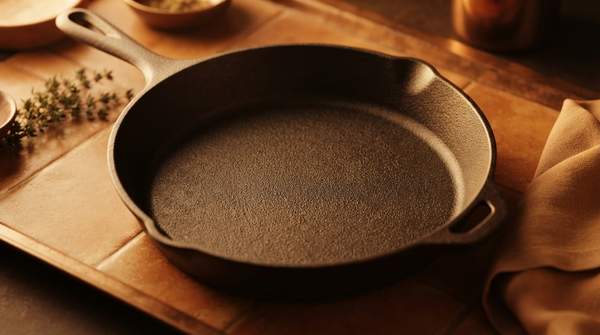
That glossy black surface on a well-used cast iron skillet is not a coating that was applied at a factory, and it is not residue that happens to resist food. It is a plastic you made yourself: a matrix of polymerized oil and carbon residue, built layer by thin layer, chemically bonded into the pores and crevices of the metal. Understanding what actually happens inside the pan when you heat a film of fat past its smoke point is what separates cooks who build durable seasoning from cooks who fight sticky, patchy, flaking pans for years.
The short version is this. Cooking oils are triglycerides, and triglycerides carry fatty acids with long hydrocarbon chains. Some of those chains contain carbon-carbon double bonds; oils rich in these unsaturated fats have more reactive sites. When a very thin layer of oil is heated to a high temperature, the chains break down, and those double bonds link together into large, complex polymer molecules that stick to the iron. Repeated cycles of thin oil and high heat build a hard, slick, water-repelling layer that resists rust and releases food. Every practical decision in seasoning — which oil, how much, how hot, how many coats — follows from that mechanism.
The Polymerization Process: From Liquid Oil to Non-Stick Surface
To see how a liquid becomes a solid cooking surface, it helps to walk the transformation as a sequence of stages. The framework below traces one seasoning cycle, from the oil you wipe on to the layer you are actually trying to produce. Each stage has a chemical event, a controlling factor, and an outcome you can check.
| Stage | Chemical process | Key factor | Outcome |
|---|---|---|---|
| Oil application | A very thin, even film of oil is wiped over the pan's surface, inside and out | Thinness — excess oil pools and stays sticky instead of polymerizing | Oil sits in and on the metal's pores and crevices |
| Heating | Heat drives the oil to and past its smoke point, where it thermally cracks | Temperature relative to the oil's smoke point | Hydrocarbon chains break down; some carbon residue is left behind |
| Polymerization | Carbon-carbon double bonds in the fatty acid chains link together into large polymer molecules | Unsaturation — more double bonds means more reactive sites | Small liquid molecules become a solid, cross-linked polymer |
| Bonding to iron | The polymer molecules adhere to the pores and crevices of the pan | Direct contact between film and bare metal | The coating becomes part of the surface rather than a film sitting on it |
| Seasoning layer | Accumulated polymerized oil and carbon residue form a hard, hydrophobic coating | Number of repeated cycles | A slick, rust-resistant, reasonably non-stick surface |
Two details in this sequence deserve emphasis. First, the breakdown at high heat is not a failure state — it is the process itself. As the Cast Iron Collector's reference on seasoning explains, when an oil is heated to and past its smoke point it thermally cracks, and part of that breakdown is polymerization, while another part is the deposition of carbon residue. The amount of carbon left behind depends on the type of oil, and a higher carbon residue content can contribute to a harder, more durable, more non-stick seasoning. Second, the polymer does not merely dry onto the metal; the molecules stick to the pores and crevices in the pan, which is why a seasoned surface survives washing and cooking rather than wiping away.
This model also explains the most common seasoning failure. If the oil layer is too thick, the surface of the film polymerizes while oil underneath remains liquid or turns gummy, because heat cannot reach it evenly. The result is the sticky, tacky pan that many cooks mistake for a failed seasoning. The chemistry did not fail; the geometry did. The fix is always the same: wipe the pan until it looks almost dry, then heat it.